Author: DCCO

See famous logos get reimagined for the coronavirus age


No Comments

03-24-2020 | Fast Company | By LILLY SMITH

Logos look a little different when they practice social distancing.

Efforts to curb the spread of coronavirus have shuttered doors, emptied stadiums, and changed lives around the world. The economic impact will be severe, although it’s too early to tell how the crisis will change global brands.

In the meantime, Slovenia-based creative director Jure Tovrljan reimagined some of the world’s most iconic logos for the new age of social distancing. Tovrljan had the idea about a week ago, he says over email, when he saw Starbucks’s mermaid logo and wondered how it would look with a mask. At that same time, coronavirus infection rates were rapidly climbing, and his social media feeds “were flooded with cheap memes about the topic,” he says. So after tweaking the Starbucks logo, he decided to make a substantive series.

Image: Jure Tovrljan

Tovrljan redesigned 12 logos from brands like Mastercard, the NBA, Nike, and the Olympics. Some updates use a simple play on words: United Airlines becomes “divided,” Nike’s eponymous “Just do it” becomes “Just don’t do it”; the U.S. Open becomes “U.S. closed”; LinkedIn becomes “LockedIn.”

“I tried to find something in every brand that communicates perfectly in normal circumstances, but is wrong in these difficult times—mermaid without a mask, Nike telling us to simply do it, Mastercard circles overlapping,” Tovrljan explains over email. “If you turn it completely around, it becomes even more powerful.”

In some redesigned logos, Tovrljan used visual sleight of hand rather than changes to the tagline to communicate our new normal. Tovrljan increased the negative space between the rings in the Olympics logo to completely separate them. He pulled apart the overlapping red and yellow circles of the original Mastercard logo, which was designed to emphasize “connectivity.” The NBA logo, which features the silhouette of a basketball player in motion, has been rotated 90 degrees for the age of social distancing: The silhouette still has one leg extended, but he’s now lying down. And the basketball is now a laptop.

Image: Jure Tovrljan

While Tovrljan’s logos are just thought experiments, some brands have made actual changes to their logos to better express this current moment of social distancing. McDonald’s Brazil has separated the Golden Arches that make up its iconic “M.” In one animated GIF version, the logo is placed above a new tagline that reads (as translated by Google Translate): “Separated for a moment so that we are always together.”

Posted by McDonald’s on Thursday, March 19, 2020

Coca-Cola, meanwhile, widened the space between the letters in its iconic script. The logo is featured in a new Times Square ad, which reads, “Staying apart is the best way to stay united.” (Times Square, for its part, remains eerily empty after New York issued a stay-at-home order.) And while it hasn’t touched its famous “Just Do It” tagline, Nike reframed the public obligation to stay at home as a personal challenge in a new ad campaign by Wieden+Kennedy.

Image: Jure Tovrljan

Tovrljan didn’t expect his series to go viral, describing the redesigns as “just an idea of how logos should look like in these difficult times,” in his original Behance post last week. But Tovrljan told me that since then, “huge brands”—even some from the original collection—have contacted him to make similar adjustments to their logos. He might have stumbled upon the sweet spot that brands are still trying to figure out: how to implement subtle design changes that acknowledge our new reality, while still maintaining the sense of familiarity we all crave.

A Neuroscientist Shares 5 Ways to Hack Productivity


No Comments

Multitasking is a myth, Sahar Yousef, Ph.D. tells us. Here, she weighs in on a few tactics to use your noggin more efficiently.

By Aileen Kwun Photography by Paul Lee | October 24, 2019 | Blog Post

Is escaping the stranglehold of Wi-Fi the new freedom? Between the constant stream of emails, Slack messages, Airtable tasks, Google Docs, iCal alerts, videoconferences, and everything in between, working in the digital age has spread us all a bit too thin, sending us on high alert at all times of day. Whether at an office, working from home, or away on vacation, it feels increasingly impossible to escape the virtual grasp of daily work demands. And that’s not even taking into account the phone calls and in-person meetings that also take us away from focused, concentrated work. 

Dr. Sahar Yousef, a UC Berkeley-trained cognitive neuroscientist and recently turned strategic consultant to businesses and startups, shares a few tips on how to break through the noise and structure your day — and mind — for higher productivity. Spoiler alert: Quit your multitasking habits now.

Take a design-it-yourself approach

Neuroplasticity refers to the brain’s ability to change throughout your lifetime, in relation to factors including behavior, process, and environment — which means the vast majority of us who aren’t natural-born geniuses with infinite potential (sorry, Einstein) can still improve our lot with strategic and incremental changes to our daily routines. Understanding these basic principles of neuroplasticity is the first step to achieving higher cognitive performance, Yousef reports. “I would say the brain is probably the most complicated thing in the universe,” she says, and while the complexity of this organ is certainly not to be understated, “I love the colloquial analogy of thinking of the brain as a muscle, because it puts the individual, the human being, in the driver’s seat. It empowers the individual in the place of truly being the designer of their own brain.”

“You are the designer, you know your brain and your own conscious experience,” Yousef says. “One example of this is being able to increase your ability to focus for longer periods of time and gain more cognitive control by training your attention. The more focus training (i.e. meditation) you do, it’s like hitting the gym, that ‘muscle’ gets stronger, and then it becomes easier to then in turn focus.”

Tap into your internal rhythm

To improve your mental acuity and performance, you have to first understand its natural peaks and slumps throughout the day. While some might swear by an early-bird schedule, jump-starting the day at sunrise and reserving less intensive tasks for a late afternoon wind-down, others might be natural night owls, passing the day with meetings and letting their minds do more complex tasks in the evening, while burning the midnight oil. As Yousef says, there’s no general rule of thumb and the preference is up to the individual, so the best way to know what time of day your mind is best functioning is to simply pay attention to your own internal rhythms.

That might be easier said for the independent freelancer or entrepreneur more in control of their own schedules, unencumbered by fixed hours at an office, though Yousef says it shouldn’t be a mystery. If you are really at a loss as to figuring out which time of day lends to optimum performance, she suggests a simple remedy, regardless of your workday setup: Keep a productivity log, beginning with a test sample of five work days. At two-hour intervals, make an active note or set an alarm to quickly jot down your physical and mental status. Chances are, you’ll find a pattern of peak performance, or sluggishness, and be able to carve out your day around that.

Understand multitasking is a myth

A good deal of empowering your mind to perform at its best depends on simple time management hacks. Step one, Yousef says, is to ignore your inbox — within good reason. The steady drip of constant email is a productivity killer, often because it’s imbued with a sense of false urgency. It can be hard to prioritize tasks with your attention divided across various apps. Add to that list Slack, unnecessary meetings, and calls, and the day often leaves little time to complete the complex work you’ve actually been hired to do. “Most people I know don’t have a workday anymore. They have these little pockets of time, between meetings and calls and answering emails, where they have 15 minutes here, 30 minutes here, 45 minutes there, and that’s their workday,” Yousef says. “Now, that’s where they’re actually doing this thing that they were hired to do: The creative work, the cognitively intensive, high-value work that’s actually going to move the needle forward for their company and for their team.”

To retrain your brain’s stamina for critical thinking and focused, concentrated work — and to manage coworker or client expectations — Yousef recommends flipping the script: Set aside one or two times a day to regularly check and respond to all your messages and emails, then close the inbox for the rest of the day. Whenever possible, structure the rest of your day in one- to two-hour chunks of focused work. And in the event of an actual emergency from a colleague or client, be a proponent for a simple proactive change in office culture. Introduce a clear protocol for colleagues to contact one another in case of an actual emergency, such as a simple phone call on your cell, and make sure you stay accountable for that agreed-upon method to establish trust. Ensuring a system for being easily reached when urgently needed, she says, can alleviate the nervous or email-happy supervisor and free up your day for actually getting things done.

Build new associations

“Our brains are constantly changing, they’re adapting, they’re learning, they’re dynamic,” Yousef says. “It’s truly a canvas, and you can change and manipulate, depending on what you’re exposing your brain to. You can create different associations.” Yousef suggests these mind-body associations can be strategically manipulated to advantageous times and places. Take for example, your desk: If you constantly find that you can only get your focused work done in the early morning at the kitchen table, before going to the office, or during moments when you manage to hide away in the quiet of the conference room, if you’re the only one there — you’re essentially telling your brain that your desk is the last place to get your work done.

Think strategically about what environment you work best in and protect any other associations from leaking into that environment. If you’re sitting at your desk and find yourself distracted and wanting to surf the internet or browse your phone, get up and leave your desk and do that elsewhere. “What is important here is intentionality in the environments we choose to do specific types of activities. That way your mind has a preset expectation about what kind of activities and what kind of thought patterns are associated with each environment. This is especially important for remote workers — be mindful of having a work zone that is only for work and don’t take your work to other areas of your home.”

Feed your mind—literally

Good mental function comes down to biology, which is why Yousef reminds us that above all, it’s important for everyone to practice basic elements of self-care, with plenty of hydration, a healthy diet, and regular exercise to keep blood flowing to your brain. Instead of turning to caffeine or sugar for a spike of energy, graze on small snacks throughout the day to keep your energy levels consistent. Above all, it’s crucial that everyone, early birds and night owls alike, get a proper and restful night’s sleep.

“One of my mottos is that there’s no ‘on’ without ‘off.’ It comes back to intentionality for me,” says Yousef. “It’s about having a ‘work hard, play hard’ attitude. When you’re at work, focus that brain: Be that brain Olympian, be that mind athlete, respect the way it’s meant to work. Fuel it and protect it. Then have intentional off-periods where you’re relaxing, you’re not processing more information, and you’re truly resting and rejuvenating.” 

Experiential Marketing | 5 Ways to Overcome Challenges & Build Meaningful Brands


No Comments

By: Brett Hyman | Visit blog

Memories elicit emotional responses. If we didn’t have those moments stored in our brains, our histories would be characterless and bland.

Brands and marketers have long recognized the potential of experiences to tie products and services to personal journeys—by making memories. My company has been doing this for 14 years. As an experiential marketing agency, we’re focused on forming memories through experiences, living by the mantra, “The right moment can transform someone forever.”

But to make a memory stick and to truly make a moment transformative, marketers face unique challenges beyond those of traditional or digital marketing. One of the biggest hurdles for experiential marketing campaigns is translating a brand—a company’s identity—into physical space in a way that encourages memory creation.

The problem is that a brand is not often understood as an experience. When we ask our clients to show us their brands, we typically receive logos or toolkits. But these are just visual representations, not the values and ideas that built the company. Strategic experiential activations require you to think beyond visual representation—you must consider whether your audience’s experience will organically represent the brand.

And even if an experience represents a brand perfectly, the resources available for building that experience don’t last forever. You can always reshoot a commercial, edit a blog post, or change an ad in Photoshop, but experiences are built in a much more finite landscape. So how do you create memories in a way that reflects not just a brand logo but what the brand truly is?

Photo by Nik Shuliahin on Unsplash

Give yourself lead time

Don’t fall into the trap of planning an experiential marketing occasion for next week or even next month. When events are thrown together last-minute, they hardly classify as experiences. Instead, make sure you have the time to think through each branch of event execution thoroughly. Ask yourself whether each part of the experience is aligned with the brand identity. If it’s not, and you’ve timed things right, you’ll have the leeway to realign instead of simply throwing something in the mix to meet a deadline.

We stay on track by developing branding grids. We use the grids as a baseline and work backward to create a schedule of deliverables and deadlines. This reduces the need to rush around and risk putting on an event that isn’t truly representative of the brand’s identity.

Keep your head in the clouds and your feet on the ground

Let your creative team get excited about the concept of your experiential marketing, but align their imaginative thoughts with logistical possibilities. It’s fine to talk about hosting a party on the moon as long as you’re not wasting valuable resources trying to make it happen. Ideas may stretch all the way there, but that doesn’t mean you’ll logically ever make it.

With the help of in-house producers, custom fabricators and experiential designers though, you may be able to recreate your version of the moon for an out-of-this-world space. Big ideas do have a place – they just need to align with brand and consumer insights for a truly impactful experience.

Don’t do what other brands are doing

Challenge your team to think of activations only your company could pull off. This means you’ll have to come up with new ideas, not simply reiterate what has been done before.

Brainstorm with your team and write down every single idea. Some may be terrible, but none will be worthless—even the bad ones can lead to good ones. You’ll probably realize a few concepts are fantastic but have little pertinence to your current brand identity. If you can’t tailor them to meet your brand specifically, trash them. That way, you won’t be investing in experiential marketing that could easily be replicated by a competitor.

Pay attention to nitty-gritty touchpoints

Walk yourself through the experience a million times before it happens, and consider forming focus groups of diverse individuals to do the same. The key is to make sure you’ve considered every way consumers will perceive and interact with your message.

HBO took this to heart when creating experiential marketing for The Inspiration Room, a project devoted to studying women’s diaries and intimate beliefs. The project includes many chances for audiences to hear from female voices as wide-ranging as Agatha Christie, Lena Dunham, and Gentleman Jack. From podcasts to workshops, HBO is controlling the narrative by anticipating how people will emotionally react to its brand and carving a niche for itself.

Take a deeper look into experiential data sets

Measuring the impact of experiences is notoriously challenging. Impression metrics and social shares can’t tell you how deeply your experience impacted your audience. Going beyond traditional marketing strategies means you must go beyond traditional metrics as well. Fortunately, new technology has been making waves in experiential analytics and helping return more useful metrics.

Radiofrequency identification technology, for instance, is one of the ways marketers can gather more consumer data on attendees. Attendees need only swipe RFID wristbands to enter an event or make purchases, and marketers can access more data on each attendee, including social accounts that can be monitored to see what’s being said about the event. Social listening, in general, is a big way marketers can measure the impact of events, and Brand Lift surveys can help gauge this pulse as well.

Marketing brands through experiences present a whole new array of hurdles that other marketing strategies don’t, but when done right, the benefits outweigh the difficulties. When brands and marketers overcome these hurdles, they create an unforgettable event. The five steps above can help you tackle the challenges to build an experience that will transform people and plant a brand in the lives and memories of attendees.

Best of 2019: Top 50 Photographs From Around the World


No Comments

Life is filled with beauty, adventure, and wanderlust. My Modern Met has narrowed life down to 50 impactful images of 2019. There is tremendous beauty to cherish in these photographs. You get to explore majestic underwater scenes, the raw beauty of nature and unique cultures that makes the world truly inspiring.

Take a look at some of my personal favorites photos of 2019 below!


By My Modern Met Team on December 16, 2019

As the clock winds down on 2019, there is a growing urge to stop and reflect on the past year—the highs, the lows, and everything in between. And the best way to take a look back at the past 365 days is through photography. Luckily, we live in an age of technology and just about everyone has a camera on hand. There are countless photographers (professionals and amateurs) who have documented all corners of the world to account for every single day. With such an abundance of images available, though, it becomes a daunting task to truly take a look back at it all. Fortunately, our team at My Modern Met has taken the time to sift through some of the most impactful images of 2019 and we’ve narrowed the list down to our top 50.

Though this year has had its fair share of emotionally charged events that have been documented, published, and shared amongst the masses—politically mobilizing and dividing people around the world—there have also been serene moments of zen captured that have allowed people to simply smile. With emotions as heightened as they are today, polarizing people from all walks of life, it’s just as powerful to be able to unify people with a funny photo.

To end this year (and this decade), we want to make sure we remember the good in the world. There is a great deal of beauty to reminisce about and cherish. From the poignant portrait of a teenager leading a generation of climate activists to the silly snapshot of a cub playfully pouncing at a “ball,” this year has ran the gamut of emotion in photographs. Majestic undersea worlds, the pure unencumbered joy of children at play, the iridescent wings of a hummingbird, phenomenal meteorological conditions, macro and micro views of our galaxy, hidden figures found in shadows, heartwarming mother-and-child portraits, and more have made the list this year. Scroll down to see the wondrous 12 months we’ve all shared via these photographers’ images.

Photo: © Harry Walker (Website) / Comedy Wildlife Photography Awards 2019
Photo: © NYC Dance Project (Website | Facebook | Instagram)
Photo: Claudio Piccoli (Website | Instagram | Facebook)
Photo: Matt Molloy (500px | Instagram | Facebook)
Photo: Andrew McCarthy (Website | Instagram | Linktree)
Photo: Steve Biro (Instagram)
Photo: Michael Shainblum (Website | YouTube | Instagram | Facebook)
Ashley Lew and Loki
Photo: Dancers & Dogs (Website | Facebook | Instagram)
Photo: Ciel Austral (Website)

MY MODERN MET
Celebrating creativity and promoting a positive culture by spotlighting the best sides of humanity—from the lighthearted and fun to the thought-provoking and enlightening.

Like My Modern Met on FACEBOOK 

5 top designers imagine the workplace of 2040


No Comments

01-29-20 | WORK IN 2040

Most will make you optimistic about the future. One will prep you for a dystopian, alternate universe. Just in case.

5 top designers imagine the workplace of 2040

[Source images: OSTILL, ghoststone, YakobchukOlena, Gugurat, Chansom Pantip, Suriya Phosri/iStock]

BY LILLY SMITH 6 MINUTE READ

The modern workplace is ripe for change. It’s safe to say that the myth of the open office as a beacon of work collaboration and efficiency has been thoroughly debunked. And somewhere between the fall of WeWork, the torchbearer for coworking spaces; the growing trend of remote work; and the gray cubicles we all remember from Office Space, we will find the office design of tomorrow. The nature of work is in flux. Therefore, the nature of office design is in flux, too.

As part of Fast Company‘s Work in 2040 package, which examines work culture, the nature of people management, artificial intelligence and data, and even how global warming will affect your 9-5 in 2040, we asked five top designers and architects to skip the immediate growing pains of shifting work culture in 2020 and imagine what the office design 20 years in the future might look like. Then we gave them free rein.

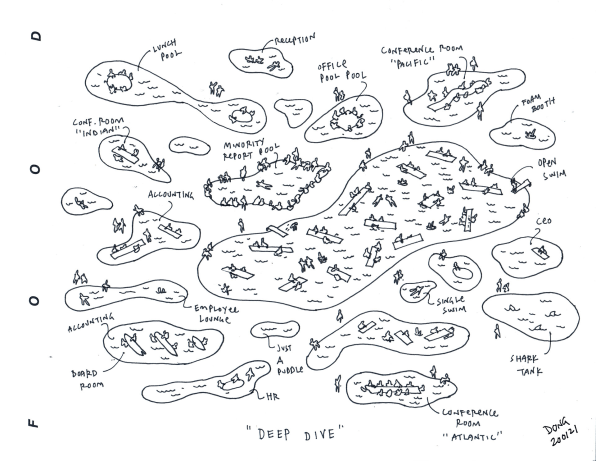
The results range from an office with streets in the sky; to biophilic architectural structures made from fungus and bacteria; to an aquatic workplace made of pools (anyone want to take a dip in the shark tank?). One thing is guaranteed—all the concepts will make you think, whoa.

AN OFFICE WITH STREETS IN THE SKY

View full size here [Illustration: Jaron Lubin, Design Principal, Safdie Architects]

Safdie Architects

The physical relationship between working, living, and playing will become more fluid—which will be more consistent with our culture. The spaces may take the form of multistory glazed (or open-air) atria and parks at the mid heights of buildings, say 20, 30, or 40 stories in the air, with indoor and outdoor spaces linked to adjacent buildings via bridges, creating networks of streets in the sky. They would capture natural daylight and breezes, feature spectacular views of the surroundings, feature gardens and other amenities, and most importantly, break down the traditional separations between the working space and the surrounding city.—Jaron Lubin, design principal

WORK, INSPIRED BY MOTHER EARTH

View full size here [Illustration: Joseph White, director of workplace futures and insight, Herman Miller]

Herman Miller

The office of the future will be unrecognizable by today’s standards, but not for the reasons that you might think. Yes, tech, tech, tech, but in 2040, workplaces will behave and feel a whole lot more like nature.

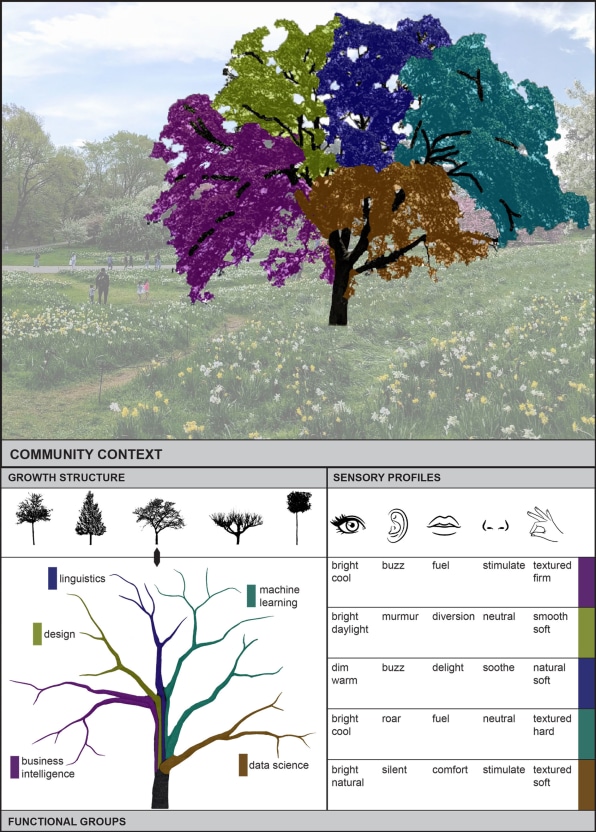
By 2040, artificial intelligence will help us master the art and science of translating complex relationships–the cultural and operational DNA of organizations–into dynamic, data-driven connections with the built environment. As new individuals join and as existing members evolve, our physical environments will adapt, just like a coral reef or rainforest that’s impacted by the addition or removal of species.

Sounds far out, but it’s not a new idea. In 1968, visionary inventor Robert Propst proclaimed, “the total behavior of an organization, its goals, values, people, defines the true growth structure required. Appropriately this is not just one thing. It is properly as variable as the difference between the structure of a rose and an oak tree. Both are alive, growing, obeying the laws of total relative adjustment but with different end goals.”

Beyond serving as a blueprint for org structures, nature also provides a guide for sensory engagement. Unlike today’s sensorially static offices, the workplace of 2040 will reflect and amplify the diversity and richness of life. Within the workplace, each functional group is distinguished by a unique sensory profile that benefits the nature of their work. As cognitive science reveals more about the mind and intelligence–both human and artificial–we’ll align the sensory stimuli of environments with the cognitive function of people. —Joseph White, director of workplace futures and insight

A WHOLE NEW MEANING TO COWORKING: SURVIVAL

View full size here [Illustration: Minnee Pham]

Studio O+A

Our vision for a workplace in 2040 cannot ignore climate change. We imagine that by 2040, the world population will have leveled off. Even though only net zero buildings will have been built since the 2020s—and despite the huge influx of people moving to urban areas—there will have been a moratorium on new construction for almost 10 years.

So desk and office sharing will be mandated of all businesses with empty or underused space. Unused space in homes will be converted to remote offices as well. Most old buildings will be retrofitted in a variety of ways for new purposes and to create more space. A new architecture of add-on or pop-up structures will blossom. The aesthetic is like barnacles. Pop-up structures often make buildings unrecognizable from their former selves. These add-on structures will be made of bambu (a fast-growing, wood-like variation of bamboo) and other living materials mostly originating from fungus and bacteria. These materials will create breathable walls and surfaces. All design will be biophilic, and plants will be everywhere, as they will help with the poor air quality and pull carbon out of the atmosphere, a task that every person young and old will pitch in on.

One positive outcome of the climate catastrophe is how the idea of work will change. With everyone coming together for the sake of sheer survival, fundamental shifts in economics and business practice will take place. International business will mostly be conducted through incredible new technologies that allow us to interact virtually through avatars. As a result, many more people will work from home, and so a host of spaces will be converted to community connection centers where people come together to exchange ideas and get their social fix, almost like the agora of ancient Greek civilization. —Verda Alexander, founder. Illustration by Minnee Pham

AN OFFICE SPACE FOR DAILY LIVING

View full size here [Illustration: Alda Ly, founder and principal, Alda Ly Architecture

Alda Ly Architecture

The workplace of 2040 feels surprisingly familiar. Technology will reduce the need for physical proximity at work, but our need for human connection and a greater purpose will remain. The office tools of the future will be open-ended, adaptable, and portable. If we can therefore take our work anywhere, why not give our office space over to daily living? In 2040, the open-office layout will be taken over by human resources—with integrated spaces for entertainment, wellness, nature, intergenerational care, and housing—fostering more meaningful connections to our environment, to our community, and to ourselves. —Alda Ly, founder and principal

AN OFFICE “DEEP DIVE” INTO WORK AND PLAY

View full size here [Illustration: Dong-Ping Wong, founding director, Food New York]

Food New York

The workplace of the future should be like every place in the future: connected with nature, integrated with the environment, and a place of productivity and joy.

With the tools that we work with becoming more mobile, and technology allowing us to work in all sorts of different places, the key for the future workplace won’t be how you work but where you work. The concept of an office space—a space dedicated to just working—will become obsolete. We can work anywhere. Why not work in places that are otherwise used to combat the anxieties and stresses of work: bathhouses, nature, places of play and fun? “Work” shouldn’t be a dedicated facet of one’s day—a necessary evil to support the more enjoyable aspects of life. It should itself be enjoyable. I love my work, and loving the environment you’re in helps you love the things you’re doing.

In both the context of climate change and just simply living on and with the Earth better, our built environments shouldn’t be seen as separate from the environments that they are built within. Separating our daily lives from the world all around us in the form of hermetically sealed, air-conditioned spaces makes it far too easy to ignore everything that we’re doing to the outdoors. The more we can connect to natural resources, the better we’ll be at taking care of those natural resources.

Also pools (and oceans and rivers and lakes) are always on the brain over here. —Dong-Ping Wong, founding director

Increase Your Click-Through Rate Using These 3 Principles of Conversion-Centered Design


No Comments

Increase Your Click-Through Rate Using These 3 Principles of Conversion-Centered Design

AARON BEASHEL – OCT 29, 2014

There’s a lot that goes into an effective email campaign, and it can be hard to know what you really need to do to make your emails convert.

You can try making sure it’s structured for scanners, ensuring your copy is compelling or making sure your call to actions buttons are awesome, but ultimately what you really need is a structure that helps you understand the fundamentals of high-converting campaigns and how to optimize your own emails before sending.

In this post, you’ll learn the 3 principles of high-converting email campaigns and see actionable tactics you can use to increase your conversion rates.

The 3 fundamentals of high converting email marketing campaigns

In our recent guide on How to get Better Marketing Results with Beautiful Design, we laid out the 3 principles of beautiful, high-converting design.

Placed in the context of optimising your email campaigns, these 3 principles are:

  1. Your campaign should motivate a person to take action – Through the design and copy of your campaign, you should be giving the reader sufficient motivation to click-through and take your conversion action.
  2. Your campaign should reduce anxiety towards taking the action – Through the design and copy of your campaign, you should be reducing any anxiety the reader may have towards clicking-through and taking your conversion action.
  3. Your campaign should make it easy to convert – Through the design of your campaign, you should make it shockingly easy for readers to click-through and take your conversion action.

These three principles form the basis of any successful email marketing campaign, and it is by applying them to the design and development of your campaigns that you’ll see great conversions rates.

But how do you do put these principles into practice? Let’s take a look at some examples of how others have done it before.

How to apply the 3 fundamentals to your own campaigns

1. Your campaign should motivate a person to take action

In order to get someone to take your chosen conversion action, you must first create desire for your product within them.

According to consumer psychologist Adam Ferrier, desire is made up of two key elements – individual incentive and social norms.

Individual incentive is the idea that people are motivated to undertake a certain behavior either for one of two reasons: to gain pleasure or to avoid pain. In marketing terms, desire to convert is created when people can see how your product or service can help them to either gain pleasure or avoid some sort of pain they have been experiencing.

That said, humans are sophisticated beings and will not simply seek out whatever creates pleasure or avoids pain with no thought to the consequences. We are inherently social, and are driven to act in a way we believe would be considered “normal” in society. So when deciding whether or not to conduct a behavior (such as taking your conversion action), we also consider things like how we will look if we perform this behavior, what the social norms are around this behavior and whether people we consider influential are undertaking the behavior.

So in order to create desire for your product, you actually need to satisfy both the individual incentive and social norm elements at the same time. You need to show people how your product will reduce pain or increase pleasure, and you need to reassure them that using your product is a perfectly acceptable behaviour to undertake.

There are a number of ways you can achieve this, including:

Use beautiful imagery

Using beautiful imagery in your email campaigns increases a person’s motivation to convert by increasing their individual incentive to own your product.

This is particularly important in visually-driven businesses like food and fashion, and Campaign Monitor customer The Restaurant understands this all too well.

In their email campaign for the launch of their winter menu, they use high-quality images of the food to stir people’s appetite, creating desire to eat at the venue and ultimately driving people to convert.

Takeaway: When using images or screenshots of your product in your marketing content, use beautiful photography to increase individual incentive and drive people to convert.

Write benefit-focused copy

Focusing your copy on the benefits of your product — rather than its features and options — helps people understand how your product can make their lives better and increases their individual incentive to convert.

This is commonly-touted advice, however when you’re strapped for time it’s easy to start writing about features and forget to write about how they actually meet the wants and needs of your audience.

To help keep you on track, there are a number of copywriting formulas that you can use. These formulas provide a structure that can help you stay focused on presenting the benefits your product offers to customers.

Our two favourites are the PAS formula and the BAB formula, and you can see the latter in action in this campaign for our recent post on the subject.

Takeaway: Focus your copy on highlighting the benefits of your product and how it helps customers gain pleasure or reduce pain. If you need some help with this, try using the BAB formula or the PAS formula to give yourself a framework to work with.

2. Your campaign should reduce anxiety towards taking action

In order to get someone to take your desired conversion action, you must also reduce any anxiety they have towards taking the action.

In marketing, anxiety is essentially any feelings of discomfort or unease towards making a conversion.

It can be caused by any number of things, including:

  • Concern that your offer isn’t worth their time and/or money,
  • Worry that your product or service isn’t the right choice for them,
  • Doubt that your product or service is reliable or can deliver what you claim it can,
  • Fear that purchasing your product is unsecure.

So in order to reduce anxiety around your desired conversion action, you must first walk a mile in your customers shoes and understand what the points of anxiety may be, and then take steps to reduce those anxieties.

Here are a few ideas of ways to reduce people’s anxiety in your email campaigns:

Show testimonials

Featuring testimonials from happy customers in your campaigns is a great way to reduce any anxiety people may have towards your product and drive more of them to convert.

However, it’s not enough to just include a small snippet from a customer about how great your product is. People don’t trust these are genuine. Instead, you need to include the customer’s name and image to increase the credibility of the testimonial and make it more effective at reducing people’s anxiety towards your product.

Campaign Monitor customer Freshbooks do a great job of this in their campaign for their ZenPayRoll integration, leveraging a testimonial from a happy customer to help reduce anxiety around the new feature.

Takeaway: Using testimonials in your email campaigns can help reduce any anxiety people may have towards your product and help drive more conversions. Just make sure your testimonial is trustworthy and includes the person’s name and image to enhance credibility.

Showcase customer numbers

Showcasing customer numbers in your campaigns can also help to reduce any anxiety people may have towards your product and drive more of them to convert.

These numbers help reassure people that your product is secure and reliable, and can be depended on to do the task people need it to do.

InVision does a great job of leveraging this in their email marketing campaigns. By including the number of other designers using InVision they create a sense of safety and security in the product that gives people the confidence to sign up and start using it.

Takeaway: If you have some impressive customer numbers, incorporate them into the design of your email campaigns to address people’s concerns that your product might not be the right choice for them. However, avoid showcasing customer numbers if you don’t yet have an impressive number. Few people like to be the first to try something and this form of negative social proof could actually increase people’s anxiety.

3. Your campaign should make it easy to convert

In order to get someone to take your desired conversion action, you must make it as simple as possible for them to take that action.

In fact, according to consumer psychologist Adam Ferrier increasing ease is one of the most effective ways to increase people’s likelihood of taking your desired conversion action.

He cites a study where researchers compared how many chocolates a person consumed when they were placed on their desk, as opposed to when they were placed a mere 2 metres away. They found that when placed on the desk, people ate an astounding 5x more chocolates than when they were just a few metres away.

This study highlights the importance of ease in getting people to convert. Even though people’s desire and anxiety surrounding eating the chocolates was exactly the same in both instances, making them easy to access increased consumption by 5x.

So how can you make it shockingly simple for your subscribers to convert? Here are a few ideas you can apply to your next campaign:

Use buttons that stand out

Using a highly-visible call to action button is one of the quickest and most effective ways to make it easy for people to convert.

When we tested replacing a call to action links with a large call to action button, we got a 22% increase in click-throughs.

Rip Curl do this well in their email campaign for the new GPS watch. The big ‘Shop Now’ call to action button leverages size and contrast to stand out from the rest of the email and ensure readers know exactly what the next step is.

Takeaway: Use a call to action button in your email marketing campaigns as opposed to just a text link, and make it stand out by choosing a colour that contrasts against the background of your email. Before you send, try using the infamous squint test to see whether you’ve made the button prominent enough or whether you need to go back to the drawing board.

Remove distracting elements

Sometimes, making it easier to convert isn’t about adding new elements like buttons and images. Instead, it can be about taking things away.

Campaign Monitor customer SitePoint make it easy for subscribers of their newsletter to convert by using a simplified design with no extraneous images or design elements.

This lack of other design elements focuses the reader’s attention on the news stories in the email, driving them to read the snippets and in turn piquing their interest to click-through to read more of the article.

Takeaway: Try removing extraneous elements from your campaigns to focus people’s attention on your key conversion actions. The added simplicity can make your calls to action stand out from the rest of the content and help funnel people into clicking them and converting.

In conclusion

By focusing on increasing a person’s motivation to convert, reducing their anxiety towards conversion and making it as simple as possible to convert, you can ensure each campaign you send will get results.

The key to putting this into action is to use the 3 principles as a lens through which you assess your campaigns. When doing so, ask yourself the following 3 questions:

  • Have I done enough to create desire and motivate the reader to take action?
  • Have I done enough to reduce the anxieties my reader’s might have towards taking the conversion action?
  • Have I made it as easy as possible for my readers to convert?

If you can honestly answer “Yes” to every one of those questions, then you’re ready to send your email. However, if one of your answers is “No”, then it may be time to go back and potential implement some of the tactics mentioned in this post to ensure you are sending an email campaign that converts.


© 2017 Campaign Monitor – Email Marketing Software

A Guide to Email Automation and the Marketing Benefits


No Comments

Landed upon a powerful guide to exploring and setting up email automations for your marketing email campaigns. Enjoy!


Introduction

Email marketing is still one of the most effective channels for marketing your business today, but it’s evolving.

While newsletters and one-off campaigns will always have their place in your email marketingstrategy, the smartest companies are starting to set up automatic email campaigns that trigger off of a user’s actions.

Why? Because these automatic emails are timely, personalized and hyper-relevant to the reader. As a result, they are opened and clicked more frequently and drive visits and revenue for your business.

Sound good? Then keep reading. In this guide, we’ll go deeper into exactly what automation is and show you 10 different types of automated email campaigns you can use in your own business to grow your revenue.

What is email automation?

As opposed to newsletters and one-off campaigns that you create and send to a whole list of people in one go, an automatic email campaign is set up once and then automatically sent to a particular individual when that person meets a certain trigger.

To give you an example, imagine you’re Facebook and you want to send an email to somebody when they signup for an account. This email will welcome them to Facebook and show them how to get started adding friends and uploading a profile picture in an attempt to get them to become a frequent user.

It would be a huge waste of your time to manually create and send an email campaign to every person when they sign up, so instead, you could set up an automated welcome email that gets sent whenever a new person joins your “Signups” list.

That’s the beauty of email automation, you can set up the email once and then as more people continue to meet the trigger you defined, the email will continue to be sent to them without you ever having to lift a finger. It essentially ‘automates’ your marketing for you.

Grow your business

Because email automation works on a basic trigger and action system (i.e., when a specific trigger happens, send this specific email or set of emails) you are really only limited in what you can do by your creativity and business needs.

To give you some ideas and help you get started, we’ve compiled this list of 10 automated emails you can start sending today that will help grow your business.


Welcome new subscribers

According to research, 96% of visitors to your website aren’t yet ready to buy. However, these people have clearly shown interest in what you have to offer and are perfect candidates to continue communicating with to try to get them to buy later on.

A great way to do this is to get them to subscribe to your email list. Subscribing to your list is a much smaller conversion action than handing over money to make a purchase, and therefore people are much more likely to do it.

Once they’ve subscribed, you can then use an automated email campaign to welcome them to your list and offer a special subscriber-only offer that compels them to buy.

This kind of automated welcome email can be set up in just a few minutes. You simply need to add an email subscribe box to your website that adds people to a list in your chosen email marketing tool and then set up an automated email to go out whenever someone joins that list.

If your eCommerce platform supports it, you can even generate a discount code and include it in the email. Not only does this provide a great incentive for people to purchase, but it allows you to track the effectiveness of the campaign and see the impact it has on sales.


Nurture your leads

According to research, 50% of leads generated by organizations are qualified but not yet ready to purchase.

The challenge with this is, how do you help move those leads along to purchase without spending too much time on them? And how do you make sure your business is top of mind when they are ready to purchase?

Using automation to set up a series of lead nurturing emails can be a great way to do this.

If you are using a CRM system like Salesforce or Highrise to manage your leads and sales, you can tag certain leads that need nurturing and then use a tool like Zapier to integrate those leads with your email marketing system.

From there, you can send a series of automated email messages over time that educates your audience on the benefits of your product and why they should use it.

Popular marketing blogger Patrick McKenzie recommends you start with a simple series of 6 emails that goes out over 30 days, and increases in “‘salesness”’ as time goes on.

The email flow he recommends is as follows:

  • The problem email – possibilities of replacing their existing process with your product. This email should focus on educating readers on the problems associated with their current method and should barely mention your product.
  • The benefit email – A look at the benefits of using a product like yours to achieve their goals. This email should focus on the benefits of using your category of product (I.e. using email marketing tools over mass-mailing from Gmail) and outline how doing so can help improve their lives.
  • The transition email – Remember, every potential customer is currently using something else to do what your product could do for them, and the act of switching from that process to using your product is a barrier you need to overcome. This email should focus on outlining a simple and easy process for making the switch from their existing solution to using your product to solve their problem.
  • The tools email – An overview of the tools available to achieve what your product achieves, almost like a quick buyer’s guide. This is the first time you introduce your product and outline why it’s superior to your competition. Include a call to action to purchase or sign up for your product for the first time in this email.
  • The case study email – A case study on how one of your customers uses your product. Make sure to outline what problems it solves for them (tied to the problems outlined in the first email) and what benefits it brings them (tied to the benefits outlined in the second email). Include a testimonial from a customer and a call to action to signup for your free trial/free plan in this email.
  • The resources email – The final email. Suggest some other eBooks, blogs, templates, kits, etc. for learning more about whatever it is your product does. You can also try including a discount code or special offer in this email as if you haven’t converted them from the previous emails a special offer could help tip them over the edge.

While this is just an example, you can see that the focus is on educating prospects rather than making the hard sale.

Only once they have been sufficiently educated on the problems of their existing approach and the benefits of replacing it with a product like yours do you introduce your product and make an offer, at which point they are much more likely to sign up or purchase.

This kind of automated email series, when sent to the leads your business generates through your website and other marketing channels, can be a very effective way to nurture potential customers through to purchase, and help grow your business.

Create an email course

Offering an email course (a number of lessons on a particular topic delivered via a series of emails) can be a highly effective way to capture subscribers and educate them on a chosen subject matter.

When executed correctly, it helps to build your email list while showcasing authority and expertise that encourages people to eventually purchase from you.

Campaign Monitor customer CoSchedule do this effectively with their 6 quick tips email course.

CoSchedule - Offer an Email Course

As you can see, the emails are well designed (making the content easily digestible) and each email contains a prominent call to action to get started using CoSchedule, helping to convert course subscribers into customers.

The result? CoSchedule has been able to add an extra 3,000 subscribers to their email list and convert countless readers into customers.

Setting up an automated email course like this is simple. All you need to do is add a form to your existing website or create a landing page to capture subscribers, then set up a basic sequence of emails to be sent out at different intervals whenever a new person subscribes to the list.

These emails can help to grow your business by showcasing your expertise and authority within your industry and building people’s desire to work with your company.


Tips for Effective Automated Email

Just like the regular campaigns and newsletters you send, automated emails need to be optimized for conversion in order to be effective.

Here are a few tips & resources to help you create remarkably high-converting automated email campaigns:

  • Write great subject lines – Even though automated email campaigns are triggered off the recipients actions, they still need to have great subject lines to grab recipients attention and ensure they get opened. To help you write a great subject line, check out these 8 subject lines formulas or the 15 power words to use in subject lines.
  • Structure your email for scanners – Research shows people don’t read email campaigns word for word like they do a book, instead, they scan the email looking for elements that pique their interest. So in order to get your message across you need to make sure your automated email campaign is structured for scanners. This post on the subject outlines exactly how to do it.
  • Use compelling copy – It’s important in your automated emails to create desire towards the conversion action, and there is no better way to do this than by using compelling, benefit-focused copy. We regularly use copywriting formulas such as the PAS formula or the BAB formula to achieve this in our own email campaigns, and they are two resources worth checking out. Alternatively, if those formulas don’t quite fit the message of your email then use these 5 persuasion techniques to help you write email copy that converts.
  • Use a call to action button – We ran some tests recently and found that including a call to action button (as opposed to just text links) increased our conversions by 28%. So when creating your automated email campaign, make sure to include a call to action button to increase your chances of people clicking through and taking your desired conversion action. It’s also important to optimize your call to action buttons, and this post provides a 3 part framework for creating the perfect CTA button.
  • Measure your results – Most email marketing tools will give you comprehensive data on email-related metrics like opens, clicks, etc. Some will even show you a real-time world map of people engaging with your email. However, to truly measure and optimize the results of your automated email you need to go beyond these metrics and look at the fundamental numbers that matter to your business, things like visits, customers and revenue. Google Analytics is a powerful and free tool to use to do this, and we’ve made a free Google Analytics dashboard that you can use to measure the effectiveness of your email marketing at a glance. If you’re more of an advanced user, check out our 4 favorite Google Analytics reports for measuring email marketing.

Wrap up

As a marketer, you likely have more and more things competing for your limited time and resources.

However, of all the opportunities available to you to grow your business, email marketing still remains one of the most impactful, and setting up automated emails can help you drive results without having to spend time working on them over and over again.

So take some of the ideas for automated emails presented in this guide and apply them to your business. Tools like Campaign Monitor make it incredibly simple to set up automated email campaigns and you can have them driving revenue for your business for years to come.


Coming up…

We will be reviewing the next steps to creating a high powered email campaign while focusing on conversation. To get a head start, visit the link below!

https://www.campaignmonitor.com/blog/email-marketing/2014/10/optimise-email-marketing-campaign-conversion/


© 2017 Campaign Monitor – Email Marketing Software

The 12 Best Marketing Podcasts to Subscribe to in 2016


No Comments

Hey podcast lovers! Check out our brand spankin’ new podcast hub to listen to the latest episodes of the Unbounce Call To Action Podcast.
podcast-roundup-2016.jpg
Image by Viktor Hanacek via picjumbo.

If being a better marketer is on that list, then we have a quick and easy way to expand your marketing  knowledge — for free! I’m talking marketing podcasts. The genius of these marketing podcasts is that they blend the actionable advice you need to be better at your job, along with some slick production and enjoyable banter.

Even better? You can listen to them anywhere. Is shedding the obligatory holiday 15 (like the freshman 15, only shortbread-induced) on your resolution list? Listen to them as you’re hitting the elliptical, like our content strategist, Dan. Or, if you’re like me, you can put one on while you cook (something that’s on the top of my resolution list).

So, without further ado, here are the best marketing podcasts as picked by Unbounce (in no particular order).

1. Marketing Over Coffee

If you want to know what the latest news is in the marketing world, Marketing Over Coffee is the podcast for you. It’s a weekly discussion of what’s new in marketing, hosted by John Wall and Christopher Penn. It’s one of the few marketing podcasts out there that is news-based rather than topic-based(most of the time). Plus, episodes are under half an hour, so pop one on during your morning commute to start your day off informed and inspired.

2. Louder Than Words

Louder Than Words is a podcast that wants you to be more successful at your craft. Focusing on creative leaders, the show tries to get to the bottom of what has made each interviewee successful in the creative space. Host John Bonini has a casual way of introducing all of the interviews, and talks to a diverse group of individuals making a substantial impact — from designers to writers to entrepreneurs.

3. Call to Action

This podcast was born from a minimum viable product (MVP) project and has since become a staple in the Unbounce marketing mix. You can expect actionable interviews with leading authors in the marketing blogospherethat dissect what truly makes a good marketer, and a successful marketing campaign (if we do say so ourselves!).

4. Copyblogger FM (formerly The Lede)

The pros over at Copyblogger recently expanded their podcast selection this year, creating a fleet of podcasts with The Lede being their longest running production. Join hosts Demian Farnworth and Jerod Morris as they talk (and joke) about what’s going on in the copywriting (and marketing) world. Expect to have your burning marketing questions answered!

5. Growth Byte

This is probably the shortest podcast you could put in your arsenal. If you’re running out the door and don’t have time to listen to a 30-minute show,Growth Byte will give you the “best startup growth content online” andsummarize it for you in two- to three-minute clips.

6. HBR IdeaCast

When you think of the Harvard Business Review, the first thing that comes to mind probably isn’t podcasting, but it’s actually on the cutting edge of media production. Host Sarah Green Carmichael sounds like your favorite NPR hosts, and she doesn’t beat around the bush — she goes straight into the interview. Expect experts ranging from professors to CEOs… even Katie Couric. As you can imagine, episode topics will center on many topics including marketing, aerospace and design. Look for their condensed episodes in the HBR print issue each month.

7. StartUp

The flagship podcast of Gimlet Media, StartUp provides an incredibly transparent look into what it’s really like starting a business. Host and Gimlet Media CEO Alex Blumberg is no podcast novice, with roots in the This American Life family — and he doesn’t disappoint with StartUp. The first season chronicles the founding of Gimlet Media, from incorporation to funding to its first employee disagreement. The second season features a new startup, but with the same delightful style you’ve come to love.

8. #AskGaryVee

This one is a little bit different in both content and format. The brainchild of self-described marketing hustler Gary Vaynerchuck, #AskGaryVee is a podcast that’s not actually a podcast. Rather, it’s a YouTube show that has been repurposed into a podcast, which is pretty clever. Gary spends 15 to 30 minutes intensely answering your most burning marketing questions. Have a question you need answered? Simply tweet him with #AskGaryVee and you may be on the next show!

9. On The Media

Coming at you from WNYC, On The Media is a podcast on the next level. Since 2001, it has been one of NPR’s fastest growing programs, heard on more than 300 public radio stations. You can expect creative interview transitions as the podcast “casts an incisive eye on fluctuations in the marketplace of ideas.” If you’ve gotten a little bit bored of marketing-only podcasts, listen to this one as a breath of fresh air, and then dive right back in.

10. Social Media Marketing Happy Hour

Aimed at entrepreneurs of all types, this 15-minute podcast (usually) comes out five days a week and will give you the inside info on how to leverage social media marketing sites like Facebook, Twitter, Instagram and more from the social experts at Happy Hour Hangouts. If you like professionally produced, banter-style podcasts, give this one a listen. Plus, it’s hosted by women!

11. Traction

Traction podcast provides an inside look into the nitty-gritty details of launching a startup… you know, the things that get glossed over in the media when you read about those other successful startups. Hosted by Jay Acunzo from NextView Ventures, this podcast boasts expertly produced interviews from founders, startup execs, media members and investors.

12. Freakonomics

Although not technically a marketing podcast, the Freakonomics podcast is filled with delightful stories that take a lot of data into account. Hosted by Stephen Dubner, with co-author Steve Levitt as a regular guest, it’s produced in partnership with WNYC so you can expect a high-quality product that will entertain, concern and baffle you (sometimes all at once!).

You can find all of the podcasts that are on our list of best marketing podcasts in the iTunes store. Do you have any other marketing podcasts that you absolutely can’t live without? Let us know in the comments.

11 SKILLS YOU NEED TO LAND YOUR DREAM MARKETING JOB


No Comments

11 SKILLS YOU NEED TO LAND YOUR DREAM MARKETING JOB

By

Dream Marketing Job

Earlier this year, the Harvard Business Review proclaimed that marketing is deadand that loyalty killed it. What does that really mean for established marketers and those looking to forge a career in the field of marketing?

In today’s business climate, consumers are frequently seeking solutions to their problems. Often, they’re able to find multiple possible solutions just from running a simple Google search. These solutions often come in the form of online tools thatmake us more productive at work, products that make our lives easier, and experiences that help us grow in both our personal lives and careers. On the flip side, you deserve to pursue meaningful work.

This means that the tools, products, and brands who are willing to offer as much value as possible to their prospective customers without requiring them pay or sign up for a 7 day trial with their credit cards, are going to build the most meaningful customer relationships.

As an active consumer and experienced content marketer myself, I can attest that establishing genuine, value-driven consumer relationships is the core of how the smartest companies are seeking to grow their influence and business today.

In order to fit the new mold for becoming a relevant marketer today, your focus and skill sets need to reflect your ability to build engaging, powerful consumer relationships with your users.

Here are the skills it’ll take to land (and excel at) your dream marketing job in today’s age.

ORGANIZATIONAL SKILLS

1. Outsourcing & Managing Content Creators.

Core to scaling your success as a content marketer will be commanding an ability to outsource content creation of blog posts, eBooks, infographics, and case studies to a pool of freelance contributors. Depending upon your content production benchmarks, you could be responsible for delivering anywhere from 2-10 high-quality blog posts per week, an infographic or two per month, an eBook every month, and a case study each quarter.

At CreativeLive, we publish around 15 pieces of content to our blog each week and have varied deliverables on the other content categories throughout the year. To help stay on track, I personally manage several freelance writers and keep them stacked up with 2 posts at all times, so they can keep working on new topic concepts that we either pitch them or they bring to my attention. I prefer to manage these relationships internally, but I’ve also used Upwork and Scripted with great success for outsourcing content production.

2. Task Management Apps.

Trello Board for ryrob Blog Content

As a content marketer, you’re going to be juggling a lot of different tasks, external communications, relationships, contributors, and content initiatives all at the same time. To stay sane, you’re going to need to enlist the help of a task management app that can keep your daily, weekly, and monthly deliverables on track. Above is a snapshot of the Trello board I use to plan out the blog content for my personal blog atryrob.com.

I’ve personally used Trello, Wunderlist, and Todoist to keep my personal task management on track, and they all have their own strengths. The company you end up working for will likely already be using one of these task management tools, so be sure to familiarize yourself now.

3. Project Management Tools.

Whether you’re a content marketer or growth marketer in your future role, you’re going to need to know your way around the most common project management tools that growing startups and established companies are using. At CreativeLive, we use both Asana and Jira for submitting feature requests, product updates, enhancements, and bug tracking. Understanding how to use these tools is essential for a new age marketer because you’ll likely be interfacing with many different teams and functional units within your company. On a daily basis, I work with content producers, our growth team, engineering, product, and instructor recruiters.

I’ve also used Basecamp, Podio, and Google Drive for project management at previous companies. I use an elaborate system of Google Drive spreadsheets to track a lot of the blog content I produce while it’s still in the ideation phase and hasn’t quite made it into Trello.

4. Cloud Storage.

The large gorilla in the room for cloud storage and online collaboration is Google Drive. With docs, spreadsheets, and presentation decks all available to use within Drive, I’ve completely cut Microsoft Office out of my workflow, in favor of saving everything in the cloud as I go. The customizable file organization structure is also a major perk to using Drive. It easily allows group collaboration, commenting, sharing access levels, and editing from your computer or mobile device.

You should also familiarize yourself with Dropbox and Box, as those are also two of the most common cloud storage apps in use today.

COMMUNICATION SKILLS

5. Email.

Yep. There’s still no way around needing to be a master at communicating, sorting, and managing a growing Gmail inbox as a content marketer. Even if your company uses an internal chat platform to cut down on email volume, your primary contact medium with the outside world will be email.

Rapportive Chrome Extension for Gmail

Bonus points if you’re familiar with Gmail’s Rapportive and Boomerang extensions for Chrome. Rapportive scans all email addresses in your inbox, and when you hover over one within a conversation, provides you with information about the contact, pulled from their LinkedIn profiles. It’s an amazing tool for guessing email addresses and getting informed on who you’re reaching out to. Boomerang allows you to schedule personalized emails to send at a later date and also lets you trigger emails to resurface in your inbox, for a reminder to follow up with a contact.

6. Team Chat.

In recent years, there has (thankfully) been a new wave of companies getting on board with using team chat applications to cut down on the amount of internal email we all receive. I’ve very happily traded an overflowing inbox for messaging platforms like Slack, Google Chat, and Skype.

7. Video Calling.

Sometimes it’s quicker or more effective to just hop on a video call and offer feedback, chat through changes, or answer a question that would otherwise require a time-intensive email. This will be especially important if you’re looking for a remote working situation, or the team you’ll be working with is dispersed across the country or world. Get familiar with Google hangouts, Zoom.us, and Skype.

TECHNICAL SKILLS

8. Analytics Platforms.

In content marketing, it’s critical to be able to communicate the effectiveness of your content to executives and fellow co-workers. This is also known as an ROI on content marketing. There’s an art and science to learning how to accurately track how much traffic your content drives, where your visitors are coming from, how many leads you’re capturing, and if you’re generating revenue from your content.

Ryan Robinson Mixpanel Course Waiting List Signups Jul-AugThis is a snapshot of my Mixpanel event tracking for signups to my personal online course waiting list over the past month and a half, which shows the flow of users through my signup and confirmation process. By using a combination of Google Analytics and Mixpanel or Kissmetrics, you’ll be able to piece together all of the above metrics that’ll help support your cause and show you the types of content that perform best with your audience.

9. Optimization Tools.

Powerful A/B testing and landing optimization tools like Optimizely and Unbounceare more within the wheelhouse of a growth marketer, but it will certainly be within your job description to make sure the pages and content you create are designed to convert visitors into subscribers and customers. With these two A/B testing tools, you’ll be able to implement in-depth tests on your own, to see whether or not visitors are more likely to convert into one of your “magic events” based on being shown different variations of your page, or even differences in things as small as CTA button color and copy.

10. Content Management System.

Unless you know the company you’re targeting for your dream job is using a CMS platform other than WordPress to power their blog and content engine, it’s safe to assume they’re on WordPress. The best way to build your skills with WordPress is to start your own blog and install WordPress as your CMS. Check out this in-depth guide for getting started with your own WordPress blog, if you need the practice today.

11. Basic Knowledge of HTML and CSS.

I’m by no means a true technical marketer, but I have a basic working knowledge of writing HTML and CSS. It has been essential for me in working with WordPress, in order to manipulate page layout, install useful code snippets, and alter the visual appearance of content on my blogs.

Once you can comfortably command a knowledge of these 11 essential skills for content marketers, you’ll be ready to go out and land your dream marketing job. For more tips and resources on how to become a more effective content marketer, join me at ryrob.com.

Get the skills you need to be a successful marketer in the digital age.

This entry was posted in Career Advice, Digital Marketing and tagged ,, on August 27, 2015 by .
https://generalassemb.ly/blog/11-marketing-skills-you-need-to-land-your-dream-job/


How to Hone Your Creative Routine and Master the Pace of Productivity


No Comments

How to Hone Your Creative Routine and Master the Pace of Productivity

by

“When you work regularly, inspiration strikes regularly.”

We seem to have a strange but all too human cultural fixation on the daily routines and daily rituals of famous creators, from Vonnegut toBurroughs to Darwin — as if a glimpse of their day-to-day would somehow magically infuse ours with equal potency, or replicating it would allow us to replicate their genius in turn. And though much of this is mere cultural voyeurism, there is something to be said for the value of a well-engineered daily routine to anchor the creative process. Manage Your Day-to-Day: Build Your Routine, Find Your Focus, and Sharpen Your Creative Mind (public library), edited by Behance’s 99U editor-in-chief Jocelyn Glei and featuring contributions from a twenty of today’s most celebrated thinkers and doers, delves into the secrets of this holy grail of creativity.

Reflecting Thomas Edison’s oft-cited proclamation that “genius is one percent inspiration, ninety-nine percent perspiration,” after which 99U is named, the crucial importance of consistent application is a running theme. (Though I prefer to paraphrase Edison to “Genius is one percent inspiration, ninety-nine percent aspiration” — since true aspiration produces effort that feels gratifying rather than merely grueling, enhancing the grit of perspiration with the gift of gratification.)

In the foreword to the book, Behance founder Scott Belsky, author of the indispensable Making Ideas Happen, points to “reactionary workflow” — our tendency to respond to requests and other stimuli rather than create meaningful work — as today’s biggest problem and propounds a call to arms:

It’s time to stop blaming our surroundings and start taking responsibility. While no workplace is perfect, it turns out that our gravest challenges are a lot more primal and personal. Our individual practices ultimately determine what we do and how well we do it. Specifically, it’s our routine (or lack thereof), our capacity to work proactively rather than reactively, and our ability to systematically optimize our work habits over time that determine our ability to make ideas happen.

[…]

Only by taking charge of your day-to-day can you truly make an impact in what matters most to you. I urge you to build a better routine by stepping outside of it, find your focus by rising above the constant cacophony, and sharpen your creative prowess by analyzing what really matters most when it comes to making your ideas happen.

One of the book’s strongest insights comes from Gretchen Rubin — author ofThe Happiness Project: Or, Why I Spent a Year Trying to Sing in the Morning, Clean My Closets, Fight Right, Read Aristotle, and Generally Have More Fun, one of these7 essential books on the art and science of happiness, titled after her fantasticblog of the same name — who points to frequency as the key to creative accomplishment:

We tend to overestimate what we can do in a short period, and underestimate what we can do over a long period, provided we work slowly and consistently. Anthony Trollope, the nineteenth-century writer who managed to be a prolific novelist while also revolutionizing the British postal system, observed, “A small daily task, if it be really daily, will beat the labours of a spasmodic Hercules.” Over the long run, the unglamorous habit of frequency fosters both productivity and creativity.

Frequency, she argues, helps facilitate what Arthur Koestler has famously termed “bisociation” — the crucial ability to link the seemingly unlinkable, which is the defining characteristic of the creative mind. Rubin writes:

You’re much more likely to spot surprising relationships and to see fresh connections among ideas, if your mind is constantly humming with issues related to your work. When I’m deep in a project, everything I experience seems to relate to it in a way that’s absolutely exhilarating. The entire world becomes more interesting. That’s critical, because I have a voracious need for material, and as I become hyperaware of potential fodder, ideas pour in. By contrast, working sporadically makes it hard to keep your focus. It’s easy to become blocked, confused, or distracted, or to forget what you were aiming to accomplish.

[…]

Creativity arises from a constant churn of ideas, and one of the easiest ways to encourage that fertile froth is to keep your mind engaged with your project. When you work regularly, inspiration strikes regularly.

Echoing Alexander Graham Bell, who memorably wrote that “it is the man who carefully advances step by step … who is bound to succeed in the greatest degree,” and Virginia Woolf, who extolled the creative benefits of keeping a diary, Rubin writes:

Step by step, you make your way forward. That’s why practices such as daily writing exercises or keeping a daily blog can be so helpful. You see yourself do the work, which shows you that you can do the work. Progress is reassuring and inspiring; panic and then despair set in when you find yourself getting nothing done day after day. One of the painful ironies of work life is that the anxiety of procrastination often makes people even less likely to buckle down in the future.

Riffing on wisdom from her latest book, Happier at Home: Kiss More, Jump More, Abandon a Project, Read Samuel Johnson, and My Other Experiments in the Practice of Everyday Life, Rubin offers:

I have a long list of “Secrets of Adulthood,” the lessons I’ve learned as I’ve grown up, such as: “It’s the task that’s never started that’s more tiresome,” “The days are long, but the years are short,” and “Always leave plenty of room in the suitcase.” One of my most helpful Secrets is, “What I do every day matters more than what I do once in a while.”

With a sentiment reminiscent of William James’s timeless words on habit, she concludes:

Day by day, we build our lives, and day by day, we can take steps toward making real the magnificent creations of our imaginations.

Entrepreneurship guru and culture-sage Seth Godin seconds Rubin and admonishes against confusing vacant ritualization with creative rituals that actually spur productivity:

Everybody who does creative work has figured out how to deal with their own demons to get their work done. There is no evidence that setting up your easel like Van Gogh makes you paint better. Tactics are idiosyncratic. But strategies are universal, and there are a lot of talented folks who are not succeeding the way they want to because their strategies are broken.

The strategy is simple, I think. The strategy is to have a practice, and what it means to have a practice is to regularly and reliably do the work in a habitual way.

There are many ways you can signify to yourself that you are doing your practice. For example, some people wear a white lab coat or a particular pair of glasses, or always work in a specific place — in doing these things, they are professionalizing their art.

He echoes Chuck Close (“Inspiration is for amateurs — the rest of us just show up and get to work.”), Tchaikovsky (“a self-respecting artist must not fold his hands on the pretext that he is not in the mood.”) E. B. White (“A writer who waits for ideal conditions under which to work will die without putting a word on paper.”), and Isabel Allende (“Show up, show up, show up, and after a while the muse shows up, too.”), observing:

The notion that I do my work here, now, like this, even when I do not feel like it, and especially when I do not feel like it, is very important. Because lots and lots of people are creative when they feel like it, but you are only going to become a professional if you do it when you don’t feel like it. And that emotional waiver is why this is your work and not your hobby.

Manage Your Day-to-Day goes on to explore such facets of the creative life asoptimizing your idea-generation, defying the demons of perfectionism,managing procrastination, and breaking through your creative blocks, with insights from magnificent minds ranging from behavioral economist Dan Arielyto beloved graphic designer Stefan Sagmeister.

Brain Pickings participates in the Amazon Services LLC Associates Program, an affiliate advertising program designed to provide a means for sites to earn commissions by linking to Amazon. In more human terms, this means that whenever you buy a book on Amazon from a link on here, I get a small percentage of its price. That helps support Brain Pickings by offsetting a fraction of what it takes to maintain the site, and is very much appreciated.